
Тема
10.01 Network And Runtime Architecture
Статус: черновик для обсуждения
1. Назначение документа
Этот документ фиксирует текущую network / runtime architecture diagram для Spinbillz / HUB v3.0.0 и объясняет, как она относится к MVP product requirements.
Документ не заменяет application architecture design.
Network diagram показывает:
- внешние actors;
- cloud/network zones;
- entry points;
- runtime services;
- managed infrastructure;
- observability components.
Application architecture отдельно должна описать:
- domain modules;
- service responsibilities;
- event flows;
- commands/events;
- data ownership;
- database schema;
- transaction processing lifecycle;
- failure/retry behavior.
2. Source diagram
Исходная диаграмма:
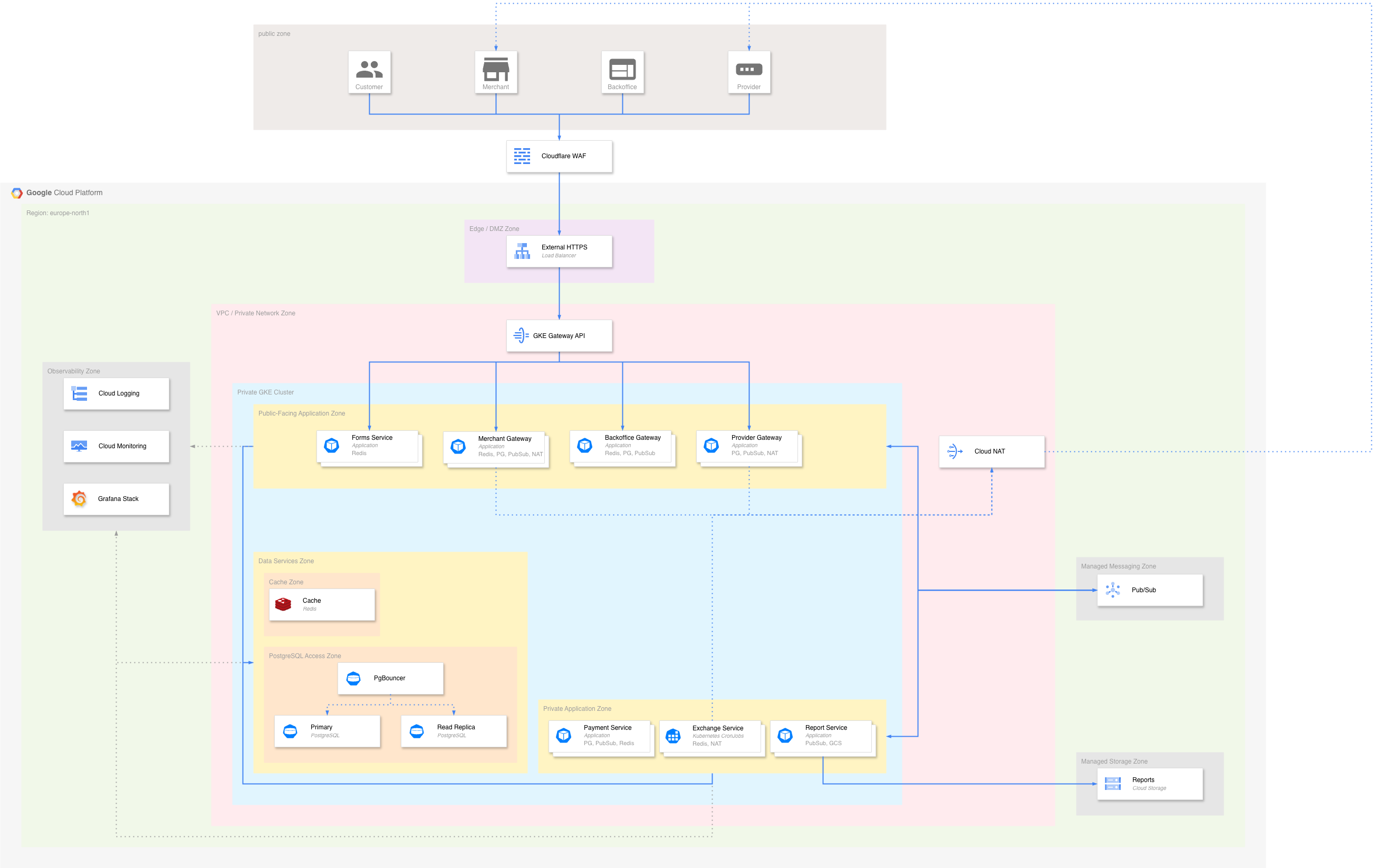
Файл диаграммы в документации:
text
product-docs-ru/10-technical-architecture/assets/spinbillz-version-3.0.0-network-diagram.png3. Что показывает диаграмма
Диаграмма показывает infrastructure layout в Google Cloud Platform.
Основные зоны:
- Public zone;
- Google Cloud Platform;
- Region
europe-north1; - Edge / DMZ Zone;
- VPC / Private Network Zone;
- Private GKE Cluster;
- Public-Facing Application Zone;
- Private Application Zone;
- Data Services Zone;
- Observability Zone;
- Managed Messaging Zone;
- Managed Storage Zone.
Основные external actors:
- Customer;
- Merchant;
- Backoffice user;
- Provider.
Основные external/security entry points:
- Cloudflare WAF;
- External HTTPS Load Balancer;
- GKE Gateway API.
4. Public-facing application services
Диаграмма содержит следующие public-facing services inside GKE:
- Forms Service;
- Merchant Gateway;
- Backoffice Gateway;
- Provider Gateway.
Forms Service
Forms Service отвечает за customer-facing hosted payment form.
В контексте MVP он связан с:
- hosted payment URL;
- payment session token inside URL;
- polling transaction/session state;
- dynamic customer fields;
- redirect to provider URL;
- customer-facing error/expired state.
Forms Service не должен содержать core business routing logic.
Merchant Gateway
Merchant Gateway является entry point для merchant API.
В контексте MVP он связан с:
POST /api/v2/deposit;- request authentication/signature validation;
- basic request validation;
- accepting merchant request even if core service is restarting/lagging;
- publishing accepted request into async processing pipeline.
Merchant Gateway должен быть thin gateway.
Он не должен содержать full domain logic routing / velocity / fees.
Backoffice Gateway
Backoffice Gateway является entry point для Back Office application/API.
В контексте MVP он связан с:
- platform section;
- merchant section;
- users/roles/permissions;
- merchant/brand/payment method configuration;
- routing blueprint editor;
- transaction details/timeline;
- audit logs;
- manual correction;
- webhook resend.
Backoffice Gateway может быть частью Back Office runtime boundary, но domain decisions должны оставаться в core application/domain layer.
Provider Gateway
Provider Gateway является public entry point для provider callbacks.
В контексте MVP он связан с:
- opaque provider callback endpoints;
- hiding real provider names from public URLs / Swagger surfaces;
- fast callback acceptance;
- storing raw callback payload;
- publishing callback into queue for async processing.
Provider Gateway не должен выполнять full callback processing synchronously.
5. Private application services
Диаграмма содержит private application zone:
- Payment Service;
- Exchange Service;
- Report Service.
Payment Service
Payment Service должен быть core business application для payment processing.
В контексте MVP Payment Service является основным кандидатом на modular monolith with DDD modules.
Payment Service должен содержать domain modules:
- Merchant / Brand;
- Payment Method / MID;
- Routing;
- MASTER MID / MASTER MID GROUP;
- SUB MID / SUB MID GROUP / SUB MID AGGREGATOR;
- Velocity;
- FX / Fees;
- Transaction Lifecycle;
- Provider Integration;
- Provider Callback Processing;
- Merchant Webhooks;
- Error Mapping;
- Audit Log;
- Timeline;
- Permissions/Visibility, если authorization реализуется на domain/application level.
Payment Service должен обрабатывать events from gateways через messaging.
Exchange Service
Exchange Service отвечает за currency rates / currency conversion support.
В контексте MVP он связан с:
- base currency EUR;
- conversion from original transaction currency to EUR;
- conversion from EUR to target/provider currency when needed;
- FX rate storage/lookup;
- conversion fee calculation support.
На диаграмме Exchange Service отмечен как Kubernetes CronJobs + Redis/NAT.
Development team должна определить, является ли Exchange Service отдельным service или module/job внутри Payment Service runtime.
Product requirement: FX/conversion behavior должен быть consistent and auditable.
Report Service
Report Service отвечает за reports/export generation.
В контексте MVP он связан с:
- CSV export by current filters;
- report generation;
- Cloud Storage for generated reports, если report generation async.
Advanced reports не входят в MVP.
Report Service не должен быть on critical transaction creation path.
6. Managed infrastructure
Pub/Sub
Диаграмма использует managed messaging zone with Pub/Sub.
В контексте MVP Pub/Sub должен поддерживать async processing для:
- merchant deposit requests accepted by Merchant Gateway;
- provider callbacks accepted by Provider Gateway;
- transaction processing events;
- merchant webhook dispatch;
- retry events;
- report generation events, если needed.
Exact topics/subscriptions должны быть описаны в application architecture / technical design.
PostgreSQL / PgBouncer / Read Replica
Диаграмма показывает:
- PgBouncer;
- PostgreSQL Primary;
- PostgreSQL Read Replica.
В контексте MVP PostgreSQL является primary system of record для:
- merchants;
- brands;
- users/roles/permissions;
- payment method configurations;
- routing versions;
- MASTER MID / SUB MID configuration;
- transactions;
- timeline events;
- audit logs;
- webhook delivery attempts;
- provider callback records;
- migration legacy transaction records.
Read replica может использоваться для read-heavy Back Office views / exports, если development team решит это технически полезно.
Redis / Cache
Диаграмма содержит Redis cache.
В контексте MVP Redis может использоваться для:
- gateway/session cache;
- hosted payment session cache;
- velocity counters, если development team выберет Redis для high-traffic counters;
- temporary locks for configuration draft editing;
- short-lived state.
Critical state не должен существовать только в Redis без durable source of truth.
Cloud Storage
Диаграмма содержит Cloud Storage for Reports.
В контексте MVP Cloud Storage может использоваться для:
- generated CSV exports;
- temporary report files;
- signed/internal access to report files, если такой подход будет выбран.
Reports in Cloud Storage не должны раскрывать secret values.
Cloud NAT
Cloud NAT используется для outbound traffic из private network.
В контексте MVP outbound traffic нужен для:
- provider API calls;
- provider redirect/API integrations;
- exchange rate source, если Exchange Service получает rates externally;
- outbound webhook calls to merchant, если architecture route требует NAT.
Provider integrations должны учитывать provider allowlist/IP requirements.
7. Observability
Диаграмма содержит Observability Zone:
- Cloud Logging;
- Cloud Monitoring;
- Grafana Stack.
В контексте MVP observability должна покрывать:
- gateway request rate/errors;
- transaction creation success/fail;
- routing outcomes;
- provider request success/fail/timeout;
- provider callback acceptance/processing;
- merchant webhook delivery/retry/exhausted;
- queue depth/lag;
- database errors/latency;
- success rate by provider/merchant/system;
- suspicious callbacks;
- secret leakage prevention in logs.
Prometheus/Grafana/internal ops scope описывается отдельно в monitoring document.
8. Как диаграмма соответствует product requirements
Диаграмма поддерживает несколько ключевых product decisions:
- entry points отделены от core processing;
- Merchant Gateway и Provider Gateway могут продолжать принимать requests/callbacks при restart/lag core service;
- async messaging через Pub/Sub позволяет decouple gateways and core;
- Payment Service на diagram соответствует core service, final application name:
Orchestrator Service; - core service является modular monolith;
- Forms Service отделяет customer-facing hosted payment form от processing;
- Report Service не находится на critical transaction path;
- Observability вынесена отдельно;
- PostgreSQL является durable system of record;
- Redis используется как supporting/cache layer;
- provider outbound traffic проходит controlled network path.
9. Что диаграмма не описывает
Диаграмма не отвечает на следующие вопросы:
- какие exact domain modules находятся внутри Orchestrator Service;
- какие commands/events используются;
- какие Pub/Sub topics/subscriptions нужны;
- как реализован outbox/inbox pattern;
- как обеспечивается idempotency processing;
- как именно routing engine выбирает path;
- где живет authorization/permissions enforcement;
- где хранится audit log;
- как versioned configuration применяется к runtime transactions;
- как устроены database tables;
- как выполняются migrations;
- как реализуется secret encryption;
- как обеспечивается zero-downtime deploy;
- какие SLO/SLA numbers считаются acceptance;
- какие services scale independently;
- какие exact retry policies используются.
Эти вопросы должны быть покрыты отдельным technical design.
10. Product-level architecture constraints
Для MVP должны сохраняться следующие constraints:
- minimal number of services;
- core business logic inside Orchestrator Service modular monolith;
- gateways thin and resilient;
- Merchant Gateway should create payment session and hosted payment URL before returning success;
- Provider Gateway should publish callback to durable queue before returning OK;
- no provider names in public provider callback URLs;
- no secret values in logs/audit/export/API responses;
- no synchronous dependency on core service for accepting provider callbacks;
- no synchronous dependency on core service for accepting merchant deposit requests, если gateway accepted request mode используется;
- merchant-facing entry points should remain available during internal restart/lag;
- report generation should not affect transaction creation;
- monitoring/metrics must be available from MVP.
11. Required follow-up architecture documents
На основе этой network diagram нужно подготовить следующие technical documents:
- Application service responsibilities.
- Orchestrator Service modular monolith module map.
- Async event flow / Pub/Sub topics.
- Deposit creation sequence.
- Provider callback sequence.
- Merchant webhook delivery sequence.
- Database schema draft.
- Outbox/inbox and idempotency strategy.
- Secrets encryption/storage strategy.
- Deployment/scaling strategy.
- Resilience strategy for gateway/core restart.
12. Acceptance Criteria
Network and Runtime Architecture считается зафиксированной для MVP, если:
- Диаграмма сохранена внутри product docs.
- Public actors описаны.
- Entry points описаны.
- Public-facing application services описаны.
- Private application services описаны.
- Managed infrastructure components описаны.
- Observability components описаны.
- Ясно, что diagram label
Payment Serviceсоответствует Orchestrator Service. - Ясно, что Orchestrator Service является core modular monolith candidate.
- Ясно, что gateways должны быть thin and async-oriented.
- Ясно, что diagram не заменяет application architecture design.
- Follow-up technical architecture documents перечислены.
13. Open Questions
Product open questions отсутствуют.
Product decision:
- Product / Project:
Payment Orchestrator / HUB v3. - Repository:
payment-orchestrator. - Core service:
Orchestrator Service.
Technical/design follow-up:
- Development team должна описать exact services/modules boundaries.
- Development team должна описать Pub/Sub topics/subscriptions.
- Development team должна описать database ownership and schema.
- DevOps/development team должна описать scaling/deployment strategy.
- Development team должна использовать application architecture decisions document as input.